Research
1. Physical Mechanisms for Computing
We study how physical fields—such as electrical, optical, thermal, and acoustic stimuli—can modulate the behavior of charge carriers or other information carriers in materials. By understanding these responses, we map them onto mathematical operations, enabling computation directly through physical phenomena. Our work spans:
·Multi-physics Modeling: Investigating coupled effects (e.g., electro-optical, optothermal, magnetoelectric) to design systems where multiple physical inputs can be processed simultaneously.
·Information Carrier Dynamics: Exploring how electrons, photons, or phonons respond to external fields and how these responses can represent arithmetic, logic, or neuromorphic functions.
·Material Platforms: Using low-dimensional materials (e.g., graphene, transition metal dichalcogenides, nanowires) for their tunable properties and strong field-response behaviors.
2. Device Engineering
We design and fabricate novel devices that harness physical phenomena to enable efficient and adaptive computing. Our focus spans three key categories:
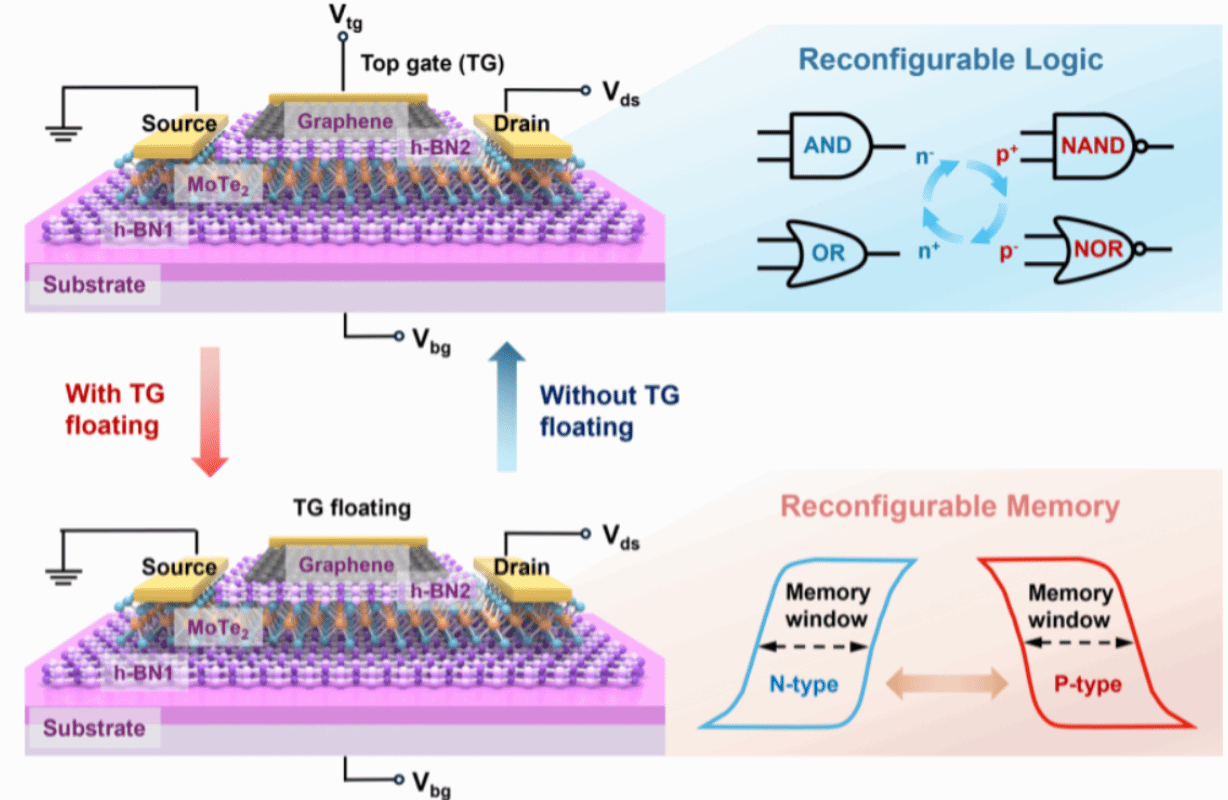
·Reconfigurable Devices: We develop hardware capable of dynamically switching between multiple functions—such as logic operations, memory storage, and signal sensing—within a single device. By exploiting field-dependent material responses (e.g., electrostatic gating, optical excitation, or phase transitions), these devices adapt their functionality based on input stimuli, reducing hardware redundancy and enabling context-aware computing.
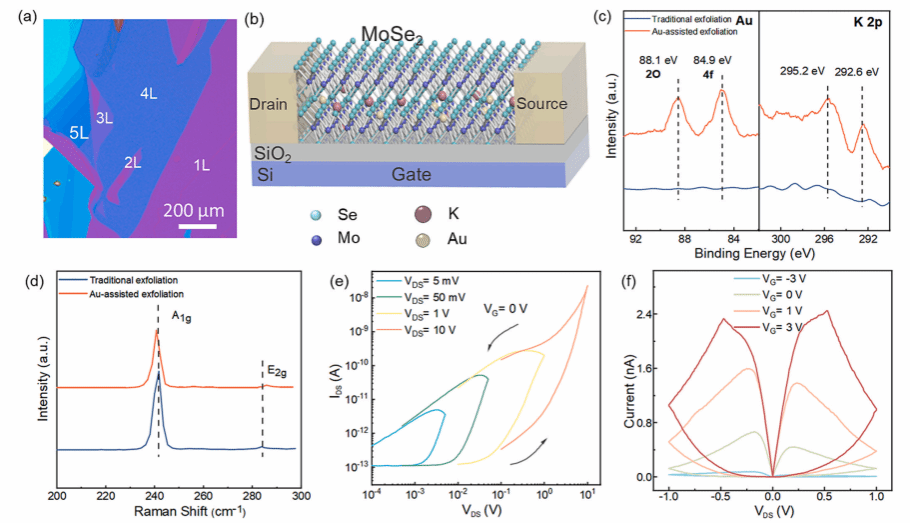
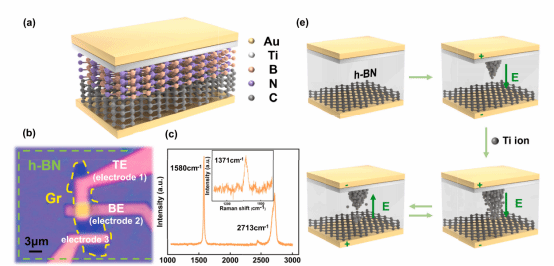
·Artificial Synapses: Mimicking the plasticity of biological synapses, we engineer devices that exhibit analog switching, weight modulation, and memory effects. Using materials like memristors, ferroelectric transistors, or phase-change systems, we emulate synaptic functions such as short-term plasticity, long-term potentiation, and spike-timing-dependent plasticity (STDP). These devices serve as building blocks for energy-efficient neural networks.
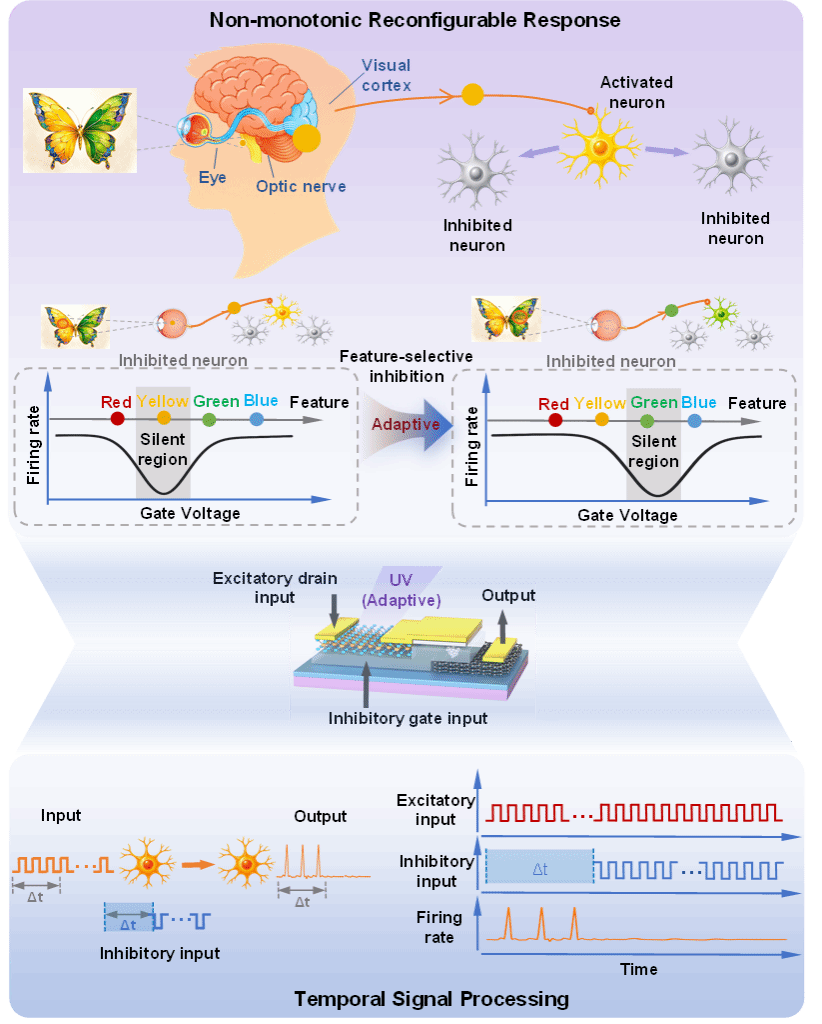
·Artificial Neurons: We design compact, low-power neuronal devices that generate spike-like outputs in response to integrated input signals. Leveraging oscillatory, threshold-driven, or relaxation dynamics in materials and circuits, these neurons encode information in temporal patterns, enabling event-driven processing compatible with spiking neural networks (SNNs).
3. Computing Architectures: In-Sensor, In-Memory, and Spiking Neural Networks
We design novel computing architectures that minimize data transfer and maximize parallel, low-power processing:
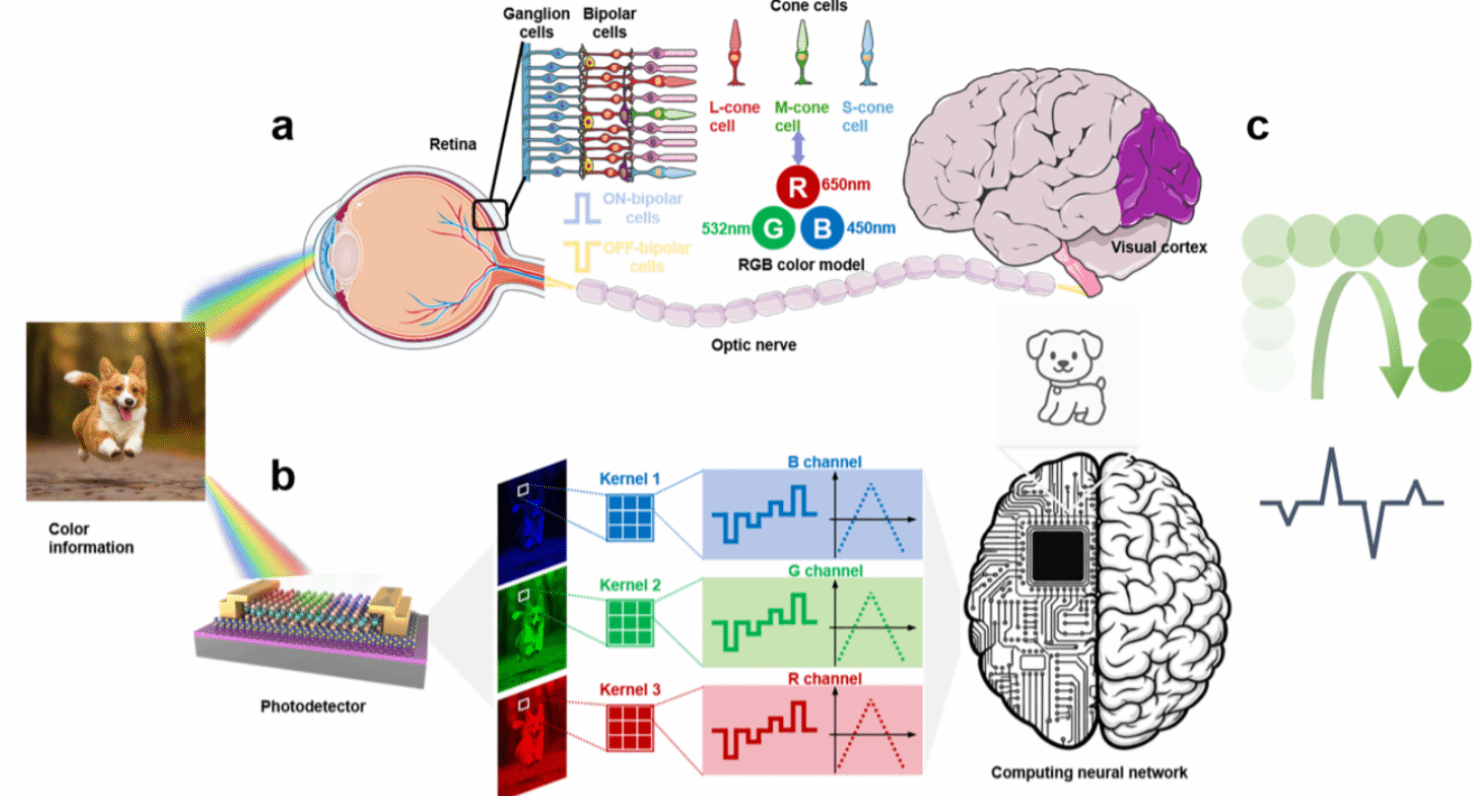
·In-Sensor Computing: Embedding computation within sensor nodes to perform tasks like image recognition, gas detection, or tactile processing directly at the source, dramatically cutting latency and energy use.
·In-Memory Computing: Utilizing non-volatile memory elements (e.g., memristors, phase-change materials) to perform logic operations within memory arrays, overcoming the von Neumann bottleneck.

·Spiking Neural Networks (SNNs): Implementing event-driven, bio-plausible neural networks that use sparse coding and temporal dynamics for efficient processing of real-world, noisy data.
Our work bridges fundamental material science, device physics, and computer engineering to enable a new class of efficient, intelligent, and physically grounded computing systems.